This is a goal the power elite cannot comprehend. They cannot envision a day when they will not be in charge of our lives. The elites believe, and seek to make us believe, that globalization and unfettered capitalism are natural law, some kind of permanent and eternal dynamic that can never be altered. What the elites fail to realize is that rebellion will not stop until the corporate state is extinguished. It will not stop until there is an end to the corporate abuse of the poor, the working class, the elderly, the sick, children, those being slaughtered in our imperial wars and tortured in our black sites. It will not stop until foreclosures and bank repossessions stop. It will not stop until students no longer have to go into debt to be educated, and families no longer have to plunge into bankruptcy to pay medical bills. It will not stop until the corporate destruction of the ecosystem stops, and our relationships with each other and the planet are radically reconfigured. And that is why the elites, and the rotted and degenerate system of corporate power they sustain, are in trouble. That is why they keep asking what the demands are. They don’t understand what is happening. They are deaf, dumb and blind.For more of Hedges' (along with Amy Goodman from Democracy Now! in the first 2 clips) spot on analysis:
Showing posts with label Economy. Show all posts
Showing posts with label Economy. Show all posts
Sunday, October 30, 2011
Chris Hedges & The Occupy Wall Street Message
Finally someone has perfectly summarized the end-game of Occupy: Wall Street. Thank you Chris Hedges:
Saturday, August 20, 2011
How the Federal Government is Funded
It is constantly claimed that over half of the people in the US "pay no taxes." Although that IS the case when you look at federal income taxes (thanks to various tax credits and deductions), it's important to realize that 58.5% of total federal tax receipts come from other sources.
The 2 charts below show the current share of federal receipts by source compared to historical highs and lows as well as a visual representation of the distribution from 1934 to 2010.
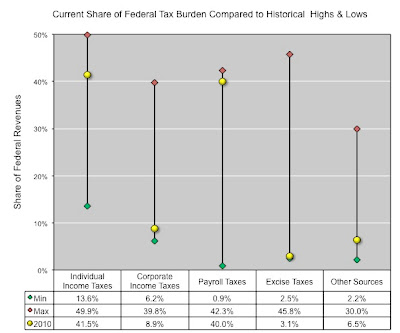
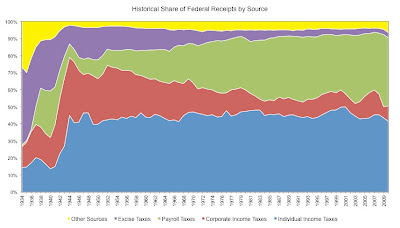
What should be evident from the data is that although over half of the US pay no federal income taxes, EVERYONE pays payroll taxes (unless you make over $106,800, every dollar of which earned over that amount is payroll-tax free OR if you make your money from investment income, which is ironically called "unearned income"), which make up an almost identical share of total tax collections as federal income taxes (40% vs. 41.5%).
When you factor in the cap mentioned above, the poor and middle class pay a disproportionately large share of payroll taxes compared to the wealthy. So although the top 1% may pay 38% of all federal income taxes, they pay a much smaller share of payroll taxes.
The other important trend to notice is that the taxes on people (income and payroll taxes) are both near all time highs but those on business (corporate income taxes, excise taxes, and other) are all near all time lows.
Is it time for the pendulum to swing back in the other direction?
For reference:
- Payroll taxes are comprised of Social Security, Medicare, Disability, Unemployment, and other retirement/health insurance taxes
- Excise taxes are comprised of taxes on alcohol, tobacco, oil windfall profits, telephone, ozone depleting chemicals/products, transportation fuels, health insurance providers, indoor tanning services, medical devices
- Other taxes include Estate and Gift Taxes; Customs, Duties, and Fees; and other miscellaneous receipts
Thursday, August 11, 2011
Annual Borrowing Costs vs. National Debt
Although our national debt is massive in absolute terms ($14 trillion+), when compared to the size of our economy, it's still very manageable (93%). In fact, it's 30% lower than it was after WWII (which we grew ourselves out of without ANY cuts in government spending), when our debt ratio peaked at 122% in 1946.
According to government statistics, our annual borrowing costs are currently only 1.5% of GDP, near all-time lows. That is less than HALF of what it was when Reagan was president (3.1%). Viewed in these terms, how can anyone claim that we are in the midst of a national debt crisis?

In case you were curious what occurred in the early 1980's that caused our debt ratio and borrowing costs to spike, it happens to coincide with the Reagan tax cuts which dropped the top marginal rate from in the 70's to the upper 20's and our deficit exploded.
Monday, August 8, 2011
Total Unemployment & Average Duration
Although the total number of unemployed Americans peaked at just over 16 million in January 2010, there are still over 14M American's currently out of work:

Although the total number of unemployed has improved from it's peak, the average unemployment duration of those currently out of work is 39 weeks and trending upwards, suggesting that the longer someone is unemployed, the further they are from finding a job. To put that into context, the average unemployment duration between 2001 and 2009 was only ~16 weeks:

Data Source: BLS.gov
Friday, August 5, 2011
Unemployment Stats
We can't forget the depths of the crisis President Obama inherited, when the economy was losing 800,000 jobs a month:

Over the past year, the private sector has steadily added jobs while government jobs have steadily been eliminated:

Data Source: BLS.gov
Thursday, April 15, 2010
Tax Day: The Reality of Class Warfare
 As the Tea Party ramps up its Tax Day protests around the country, I'd like to introduce some facts and reality to the equation.
As the graph on the right shows (courtesy of the geniuses at WolframAlpha), the average federal tax rate in 2007 was 12.84%, a far cry from the 40% the median Tea Partier believes the rate to be.
The bar chart, however, paints an even more telling picture. How have the ultra wealthy (those making more than $2M annually) changed our tax system from PROgressive to REgressive? If this is proof of blatant class warfare, I don't know what is...
To quote Warren Buffett:
“There’s class warfare, all right,” Mr. Buffett said, “but it’s my class, the rich class, that’s making war, and we’re winning.”
Also,
as he said at a $4,600-a-seat Hillary Clinton fundraiser in 2007:“The 400 of us [here] pay a lower part of our income in taxes than our receptionists do, or our cleaning ladies, for that matter. If you’re in the luckiest 1 per cent of humanity, you owe it to the rest of humanity to think about the other 99 per cent.”
Is that the type of country we want America to be?
Saturday, September 26, 2009
Michael Moore and Wolf Blitzer
If you haven't seen Michael Moore making the TV circuit to promote his new movie, Capitalism: A Love Story, the clips below showcase his best performance. He makes Wolf Blitzer looks like an amateur, with repetitive, sound-bite inspired questions:
My favorite moment came when Wolf asked Michael how he would respond to allegations that he is being hypocritical in his movie because he himself has benefited and become wealthy from our capitalistic system. To which Michael Moore responded:
"I wonder if there was a Wolf Blitzer 200 years ago who asked Thomas Jefferson, or John Adams, or George Washington: "Hey you guys are wealthy land owners, you've benefited from the Kings system, what are you complaining about? whats this revolt all about?"
Brilliant.
PS: If you missed Wolf's appearance on celebrity Jeopardy, you missed the man who represents one of the supposed leaders in cable news making a fool of himself and getting blown out by comedian Andy Richter. His grand total: -$4600.
My favorite moment came when Wolf asked Michael how he would respond to allegations that he is being hypocritical in his movie because he himself has benefited and become wealthy from our capitalistic system. To which Michael Moore responded:
"I wonder if there was a Wolf Blitzer 200 years ago who asked Thomas Jefferson, or John Adams, or George Washington: "Hey you guys are wealthy land owners, you've benefited from the Kings system, what are you complaining about? whats this revolt all about?"
Brilliant.
PS: If you missed Wolf's appearance on celebrity Jeopardy, you missed the man who represents one of the supposed leaders in cable news making a fool of himself and getting blown out by comedian Andy Richter. His grand total: -$4600.
Friday, August 14, 2009
Another Pending Crash?
 Two articles from Bloomberg caught my eye this afternoon.
The first, which is the source of the above graphic, indicates that there may be a massive swell in US bank failures in the near future. According to the article:
One thing the article fails to mention is why a ratio as low as 5% is such a problem. Unless I am mistaken, it is because of the way our banking systems' fractional reserve lending works. By law, banks must keep the ratio of outstanding loans to assets at 10:1, or to put it another way, for every dollar the bank has in deposits, they can loan out $9. That means that a "well capitalized" bank will have only 10% of its outstanding loans on hand.
- "More than 150 publicly traded U.S. lenders own nonperforming loans that equal 5% or more of their holdings, a level that former regulators say can wipe out a bank’s equity and threaten its survival. The number of banks exceeding the threshold more than doubled in the year through June, according to data compiled by Bloomberg, as real estate and credit-card defaults surged. Almost 300 reported 3% or more of their loans were nonperforming, a term for commercial and consumer debt that has stopped collecting interest or will no longer be paid in full."
- "Also left out were the 19 lenders that underwent the Treasury’s stress tests in May; they were deemed “too big to fail” and told by regulators that government capital was available to keep them in business."
- "Excluding the stress-test list, banks with nonperformers above 5 percent had combined deposits of $193 billion, according to Bloomberg data. That’s almost 15 times the size of the FDIC’s deposit insurance fund at the end of the first quarter."
In the other article, the chief portfolio strategist for bear markets at Federated David Tice claims that US stocks are "dramatically overpriced."
According to his numbers, the recent bull market pushed the S&P 500s' price-to-earnings ratio to the highest it's been since December 2004. To put an exclamation point on his findings, the article goes on to say:
Tice said he’s the most confident ever that the stocks will fall beneath their March lows. A drop to 400, a 61 percent plunge from yesterday’s close, is likely within a year, he said.What would our economy look like if the S&P 500 dropped to 400? Would we even have an economy left? Would we even have a functioning government?
The Redistribution of Wealth...Upward

After all the sturm and drang from the Republicans about President Obama's socialist agenda to "spread the wealth around," a new paper from University of California, Berkeley Professor Emmanuel Saez shows that that has already occured...but in an upward direction. The above graph illustrates just how bad the situation is.
What Professor Saez found, to quote Paul Krugmann of the New York Times, was "truly amazing:"
- since 2000, just the top 0.01% of income earners DOUBLED their cut of the nations total income to 6%
- As of 2007, the top 10% of American earners accounted for 49.7% of total wages, a level "higher than any other year since 1917 and even surpasses 1928, the peak of stock market bubble in the 'roaring" 1920s.'"
- "The top 1% incomes captured half of the overall economic growth over the period 1993-2007"
- "...while the bottom 99% of incomes grew at a solid pace of 2.7% per year from 1993-2000, these incomes grew only 1.3% per year from 2002-2007. As a result, in the economic expansion of 2002-2007, the top 1 percent captured two thirds of income growth."
Tuesday, August 11, 2009
The Broken Labor Market
 One of the theories behind the destruction of the Middle Class is that as productivity skyrocketed in the 80's and 90's, while wages failed to keep pace. With productivity creating supply and wages driving demand, this created an imbalance in our economy. In order to fill in the shortage of demand (i.e. wages), the Federal Reserve dropped interest rates to loosen the credit market and banks started to offer attractive home equity lines of credit. So according to this theory, the crisis that we are in occurred because the American consumer hit his/her credit limit, causing demand to plummet and grinding our economy to a halt.
But why do I mention this? According to the Labor Department, wages have grown by 1.8% over the past year, the lowest increase ever recorded. Looking at 2009, wages increased by only 0.3% in the first quarter and 0.4% in the second. Comparing those stats to the productivity gains seen over the same quarters shows that we are doing nothing to "fix" the fundamentals of our economy, i.e. mismatched supply and demand. According to Bloomberg:
The productivity of U.S. workers grew in the second quarter at the fastest pace in almost six years as employers slashed payrolls to bolster profits. Productivity, a measure of how much an employee produces for each hour worked, rose at an annual 6.4 percent pace, more than forecast, after a 0.3 percent gain the prior three months, Labor Department data showed today in Washington.What does this mismatch between productivity and wages mean to business? Bloomberg goes on to say:
The productivity report showed labor costs decreased at a 5.8 percent pace, the second consecutive fall and the biggest since 2001.So if you're curious as to how the stock market can be hitting new highs even though none of the fundamentals of the economy have changed, in my opinion, you have to look no further than this report. Companies are increasing their profitability by shedding labor costs, not by increased sales/business.
So when you hear the term "jobless recovery," realize that there is no such thing. Until wages have risen enough, or prices deflate enough, there will still be a mismatch between supply and demand and our economy will continue to sputter along. I just hope we don't end up like Japan and their "lost decade"
Monday, August 10, 2009
Economic Recovery?
 If you are considering divesting your retirement money back into equities, you may want to think again. The above chart, from Bloomberg.com, illustrates the problem.
Comstock Partners has stated that government efforts can't “solve a problem of excess debt generation that resulted from greed and living way beyond our means...We could wind up with a lost couple of decades.”
According to the Federal Reserve Bank of San Francisco, if private borrowers reduce their debt at the same rate as Japan's did after its economic bubble burst in the 1980's, savings rates will continue to climb to about 10% in 2018. This could inhibit growth in U.S. consumer spending, which makes up 70% of our GDP, by 0.75% annually on average during the next nine years.
This uncertainty in the markets is also apparent in the VIX, the "fear" index, which is indicating that the biggest bull run the market has seen since the 1930s won't last through September. According to last week’s reading, there is a 68% likelihood the S&P 500 will fluctuate as much as 7.2% in the next 30 days. From a historical perspective, the same upward-sloping curve occurred last August before the S&P 500 fell 9.1% in September and 17% in October. Ironically, September has also historically been the worst performing month.
On a slightly partisan note, if you look at the chart of Debt vs GDP, it's clear when our country started to live beyond it's means: the 1980's. More interestingly, this is the same time that Ronald Reagan took our top marginal tax rate from 70% to 28% over a 7 year period, while at the same time increasing taxes on the middle class through increased social security and medicare taxes. After the massive tax cuts for the wealthiest Americans, is there any wonder why the ratio of debt to GDP skyrocketed?
So, if you are looking for a point where the redistribution of wealth upward began, look no further than Ronald Reagan. In 1979, the top 1% owned 20.5% of the nations wealth. By 2004 (the latest I could find data) that number had grown to 34.3%, after peaking at 38.5% in 1995. I assume that drop was due to the market crashes of the late 90's and early 00's, so I'm sure the ratio peaked again in 2007 before the credit crunch.
Banking: "Heads I win, Tails you lose"
 New York Attorney General Andrew Cuomo has just released his analysis of the compensation of the 9 largest banks participating in the Troubled Asset Relief Program, or the TARP, and the conclusions are rather shocking. (The above chart shows just how ridiculous bonus payments were in 2008 alone and comes from the AG's report, linked above)
Despite the executive claim that "employees should share in the upside when overall performance is strong and they should all share in the downside when overall performance is weak," their bonus structures can be summed up as "heads I win, tails you lose."
According to a Wall Street Journal review of the report:
The $32.6 billion in bonuses is one-third larger than California's budget deficit. Six of the nine banks paid out more in bonuses than they received in profit. One in every 270 employees at the banks received more than $1 million.Although the report is full of financial information, I feel the most striking data can be seen in the following the chart I put together:

So while the White House is on the record as saying:
"The president continues to believe that the American people don't begrudge people making money for what they do as long as...we're not basically incentivizing wild risk-taking that somebody else picks up the tab for"How is that not the situation we are currently in?
So for anyone who thinks a pay czar is too much socialism, I ask what are the other options? If the banking sector won't responsibly reform themselves from the inside, how is it NOT the proper role of government to step in and fix the problem?
Just to add insult to injury, at the same time that the banks are taking unprecedented amounts of "free" money from the government and Federal Reserve, they are also increasing their overdraft fees. If current trends continue, banks stand to collect a record $38.5 billion in overdraft fees alone, double what they brought in in 2000. In fact, 5 of the 10 largest banks have increased their overdraft fees within the last year, raising the median overdraft fee from $25 to $26, the first increase during a recession in 40 years. The largest banks (with over $50 billion in assets, i.e. Bank of America, Citigroup, JP Morgan Chase, and Wells Fargo) charge even more, with a median fee of $35.
What makes this practice so destructive is that it disproportionally affects the poorest depositors and those with the lowest credit ratings. According to Moeb Services, 90% of overdraft revenues come from just 10% of the 130 million checking accounts in the US. After taking so much taxpayer money, how can we let the banks do this?
Friday, August 7, 2009
Irrational Markets Part 2

Today, AIG announced a $1.8 billion second quarter profit, it's first since 2007. Bolstered by this "optimistic" news, AIG's share price closed out an impressive week of gains at 27.14 (after opening the week at only 13.18). That means that in the last 5 days, AIG's market value has more than doubled. The chart above, from Yahoo!Finance, shows AIG's weekly share price data.
However, if you dig a little deeper into AIG's financial release, it's clear that this "profit" was completely manufactured through accounting tricks. According to the Financial Times, who did the digging:
- Their profit was driven by lower writedowns on toxic assets, due to improvements in credit markets and changes to accounting rules (i.e. the mark-to-market rule that was eased in April), and not by increased revenues.
- According to Ed Liddy (the former government-appointed CEO of AIG), a reduction in credit from the New York Fed would cost AIG $5 billion in future quarters.
- Operating income in general insurance fell 20% as premiums dropped
Irrational Markets
 The Department of Labor announced today that the "official" unemployment rate decreased from 9.5% to 9.4% during the month of July. Because of this "good news," the market climbed over 100 points today. However, after a closer look at the data, I would love to know why this was received as good news.
Buried in the announcement, as reported by cnn.com, was the following information:
- Although there was a net loss of 247,000 jobs in July (the fewest job losses since August 2008), the Labor Department's unemployment rate dropped due to revised job loss numbers for June and 237,000 people it stopped counting as unemployed (i.e. they became what are known as discouraged workers, they retired, or they went back to school)
- The average hourly work week increased to 33.1 hours, up from a record low of 33.0 hours in June (still not close to a full-time work week).
- The number of workers who wanted full-time work but could only find part-time jobs fell by 191,000, or 2%. By backing out that percentage, I arrive at the massive number of over 9.5 million Americans who are "under-employed."
- The number of people unemployed for more than six months reached a record high of nearly 5 million people.
- The average time of unemployment has reached 25.1 weeks, the longest ever recorded.
- According to FT.com, over 16% of people in the US are currently unemployed, underemployed, currently reskilling, or discouraged.
Because I'm not an economist, I'll end this with two quotes from experts (from an article in at FT.com):
“A more hopeful sign would be a sharp increase in the rate of unemployment due to people re-entering the workforce” - Joseph Brusuelas, director of Moody’s Economy.com
“This is almost like you’ve had a 20 pound weight dropped [on your head] and now it’s a 10 pound weight: It’s still really bad news” - Peter Morici, professor of economics at the University of Maryland.
Tuesday, August 4, 2009
Banking in America: 2009
 Just weeks after announcing massive profits, it appears that the banking sector made them off of the backs of the taxpayer, NOT by increased lending or refinancing.
JP Morgan Chase, Bank of America, Goldman Sachs, and Citigroup alone announced profits totaling $13.6 billion for the second quarter, just 6 short months after losing a combined $20.8 billion. That is a net turnaround of $34.4 billion in half a year. If you were to step back even further, according to Presido, the 115 banks that participated in the TARP managed to turn their 2006 combined profits of $119.3 billion into a loss of $19.3 billion in 2008, totaling a net turnaround of $138.6 billion in 2 years. Over that same period, roughly 33% of CEOs and 40% of CFOs at these very same banks saw their direct compensation rise, primarily through increases in stock options of 71% for CEOs and 59% for CFOs. So not only did the banks destroy our economy, their executives got paid more to do it.
To make matters worse, New York State Attorney General Andrew Cuomo just released a report showing that in 2008 several financial institutions that received bailout money gave bonuses that greatly exceeded the amount of profit generated by the banks. For example, according to CBS News:
• Goldman Sachs, which earned $2.3 billion last year and received $10 billion in TARP funding, paid out $4.8 billion in bonuses in 2008 - more than double their net income.According to a Wall Street Journal article from back in April, the major recipients of the TARP contracted their lending and refinancing by 23%, as compared to when the program began in October. The decline was so widespread that only 3 of the TARP's 19 largest beneficiaries had an increase in new loans and the total dollar amount lent declined in 3 of the first 4 months of the program. According to the Treasury Department (compiled by the Wall Street Journal), the decrease in lending per bank is as follows, with a median value of -2.2%:
• Morgan Stanley, which earned $1.7 billion last year and received $10 billion in bailout funds, handed out $4.475 billion in bonuses, nearly three times their net income.
• JPMorgan Chase, which earned $5.6 billion in 2008 and received $25 billion from the government, paid out $8.69 billion in bonus money.
• Citigroup and Merrill Lynch lost a combined $54 billion last year. They received a total of $55 billion in bailouts and paid out $9 billion in combined bonuses. ($5.33 billion for Citigroup; $3.6 billion for Merrill Lynch, which was subsequently acquired by Bank of America, which was just fined $33 million by the SEC for misleading investors about the Merrill bonus payments.)

Perhaps the banks have been failing to loan money because they were too busy refinancing delinquent loans through Obama's $75 billion Making Home Affordable program? Think again. Here are the percentage of eligible loans currently being modified, broken down by bank according to the Treasury Department:
- Wachovia: 2%
- Bank of America: 4%
- Wells Fargo: 6%
- Citigroup: 15%
- JP Morgan: 20%
- GMAC: 20%
- Aurora Loan Services (a former unit of Lehman Brothers): 21%
- Morgan Stanley’s Saxon Mortgage Services: 25%
What a system...
Monday, August 3, 2009
The "Success" of Cash for Clunkers
 As many in the media trumpet the success of the "Cash-for-Clunkers" program, I'd like to point something out from an article that ran in the Financial Times today:
According to transportation department data, Toyota accounted for three of the top 10 models bought under the cash-for-clunkers scheme. Honda and Ford had two each, and GM and Chrysler one each.So, with 7 of the top ten cars sold under the program being foreign-made, cash-for-clunkers has been very successful at stimulating the economies of Japan and South Korea, but not so much for ours. Should Congress have considered a "Buy American" clause in the legislation? It may have discouraged some of the car buyers, but it would have led to a greater domestic stimulus.
However, as far as the programs environmental impact is concerned, it has been an overwhelming success:
The government estimates the average fuel consumption of vehicles bought under the programme is 25.4 miles per gallon, compared with an average 15.8 mpg for trade-ins.The only question left is whether or not the Senate will pass the $2 billion supplement to the program. Many Republicans, John McCain for one, have already pledged to block it.
Dennis Kucinich: Why We Need To Audit The Fed
During a segment on the Thom Hartmann show last Wednesday, 7/29, Rep. Dennis Kucinich (D-OH) walked through his argument for why he, along with Republican Ron Paul and others, inserted an amendment, which passed the House, into a recent bill that would allow Congress to audit the Federal Reserve. Take a listen, it's worth the 3 minutes of your time.
I had no idea this was happening.
Dennis Kucinich is, in my opinion, one of the most important, progressive voices in all of Congress. If you aren't familiar with his passion, like his "Wake Up America" speech from the Democratic Convention last year, check out the video section of his website.
I had no idea this was happening.
Dennis Kucinich is, in my opinion, one of the most important, progressive voices in all of Congress. If you aren't familiar with his passion, like his "Wake Up America" speech from the Democratic Convention last year, check out the video section of his website.
Wednesday, July 29, 2009
This Isn't Capitalism
 I posted a story a few days ago about the lack of enforcement of our nations antitrust laws, and something caught my eye today that I feel is relevant to add to the story.
Yesterday, the Financial Times reported that Sprint-Nextel would be acquiring Virgin Mobile USA for $420 million. The deal would add Virgin's 5.3 million pre-paid subscribers to the 4.3 million Sprint-Nextel already had through their Boost Mobile brand. The reason I find this interesting is because in today's Financial Times, Sprint-Nextel announced that its net loss, year over year, had widened by 12% to $384m in the second quarter.
If the company is losing money, why are they buying up competitors? At what point does Sprint-Nextel attain the "too big to fail" moniker? Where is the competition in the telecommunications business? It's gotten to the point that there is no way to NOT support one of the telecom giants who assisted the NSA with Bush's illegal, domestic spying program. As a side note, Qwest was the only major company who refused to participate in the program because "it was uneasy about the legal implications of handing over customer information to the government without warrants." What a novel concept.
I can already hear the telecoms pitching their need for a bailout from congress because if they were to fail, the US economy would grind to a halt. When our economy is being run by monopolies (Banking, Insurance, Telecom, Agri-business, etc), unregulated capitalism has reached its final stage...
Tuesday, July 28, 2009
Health Care "Inflation"
 When Clinton tried to overhaul the health care system back in 1993, 40 million Americans were uninsured and it cost $912 billion. Now, only 15 years later, the number of uninsured has increased to almost 50 million and Americans spend $2.5 trillion. That is a 25% increase in uninsured Americans and a 174%, or 11.5% annual, increase in cost. With inflation typically running around 3%, why is inflation in the health care industry almost 4 times higher?
Some other interesting facts to keep in mind as PhRMA, the drugmakers lobby, launches its $100 million ad campaign against health care reform:
- Premium costs are projected to rise another 9% next year, an increase that 42% of employers plan to pass on to their workers, according to a report last month by PricewaterhouseCoopers
- Earnings per hour climbed by a 0.7% pace on average over the last three months, the Labor Department said earlier this month, the smallest gain since the agency began keeping records in 1964
- The share of insured workers with at least a $1,000 deductible has almost doubled since 2006 to 18%
- Health-care spending will account for 20% of U.S. gross domestic product in 2018, or $1 in $5 spent, compared with 16% of GDP, $1 of $6 spent, in 2008 (As a point of reference, Canada's system costs 10% of their GDP and the average of all 30 members of the OECD is 8.9%. That means we currently spend twice what the world does for their health care)
Sunday, July 26, 2009
Global Worker Unrest
 A story in the Financial Times today caught my eye and I thought I'd make a quick inter-country comparison of how each countries workers handle their disagreements with management. I'll start with the extreme example.
In China:
Tonghua Iron & Steel, a state-run enterprise with about 50,000 workers, had been in privatization talks with Jianlong Group, one of China’s largest privately-held steel companies, when the workers rebelled. After the manager, Chen Guojun, stated that he was going to lay-off all of the workers, they beat him unconscious then stopped an ambulance and police from entering. The manager died because of the attack.
In France:
France has several interesting examples. Two weeks ago, workers facing lay-offs at a Nortel Networks research center that is being closed in Châteaufort, near Paris, threatened to blow up their factories unless they receive more severance pay. They later admitted the bomb threats were a hoax. Back in April, workers at two Caterpillar plants in Grenoble, France, kidnapped five of their management team in their offices after the company announced it would be laying off 733 employees. More examples of the French workers "kidnapping strategy" can be found in this comprehensive article from the Washington Times. Though this strategy sounds extreme, the workers typically treat their "hostages" very well and mainly used the tactic to bring media attention and awareness of the issue to the rest of the country.
In the United States:
The only example of a successful worker rebellion (other than a strike) that I can remember in the past few years was the sit-in last year at the Republic Windows and Doors factory in Chicago that ended with the company getting an emergency loan that kept the factory open.
Why is it that extreme examples of worker protests don't happen in America any more? Where are all of the protests, like the ones in the '60s and '70s that made America famous? I ask because, according to the Organisation for Economic Cooperation and Development, the United States has the highest rates of poverty and inequality of it's member countries, with the exception of Mexico and Turkey. The OECD was formed in 1960 and currently has 30 members, that you can see here. The first link in this paragraph takes you to the OECD individual report on the US also has some other very interesting statistics, so I highly suggest clicking it.
Could America's worker's response to management be so docile because of the fact that their economic well-being is so fragile? I'm not advocating violence or bloodshed, but where are the domestic protests?
Subscribe to:
Posts (Atom)


 Posts
Posts