Showing posts with label Media. Show all posts

Sunday, August 23, 2009

What was Yahoo! Thinking?

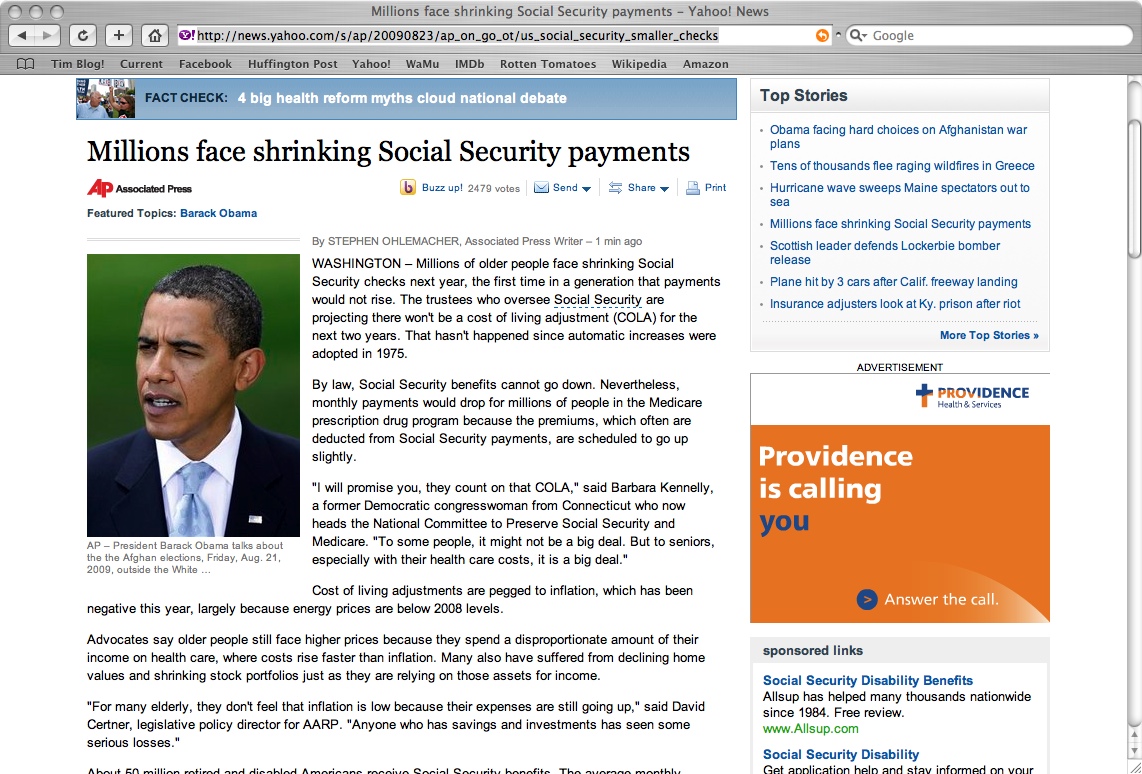
I was checking the news on Yahoo! today and came across an article entitled Millions Face Shrinking Social Security Payments in which I found something incredibly dishonest. Along with the article, directly below the headline, was a picture of President Obama, leading the reader to make a visual link between the president and the headline implying that it is because of him that social security payments will be going down.

The caption on the picture, written in light grey in tiny letters, is as follows:

"President Obama talks about the Afghan elections Friday, Aug. 21st, 2009, outside the White..."

So the picture isn't even associated with the article! How can they be so intellectually dishonest? Why does the media want seniors to be so afraid of the President?

Here is a screenshot of the article:

To make the issue even worse, the article states that the amount of the checks will NOT be decreasing (which would be illegal) but would be remaining the same, with no cost of living adjustment. The reason that the checks will be "shrinking" is because of increased premiums for medicare.

So, embedded in the article is another reason why we need to reform the health care system, but Yahoo! chose to portray the article as President Obama personally taking money away from senior citizens. Add that to the death panel lies and a pattern of scaring seniors starts to emerge...

What could their motives possibly be?

Friday, August 14, 2009

Where is the Single Payer Debate?

With all of the attention on the pending health care overhaul focusing primarily on scare tactics, misinformation, and rowdy town hall meetings, one option has flown conspicuously under the radar: a national single-payer system, or more easily understood as Medicare-for-all. The benefits of such a system, which President Obama supported as a Senator, include:
  • health care delivery would remain private, i.e. private doctors, private hospitals, etc
  • the government would act as the sole provider of health insurance which would drastically reduce paperwork and administrative costs (medicare operates at a 3-4% overhead as compared to 30-40% for the average for-profit insurance company)
  • no more insurance executives making hundreds of millions or, in the case of GroupHealth executive Bill McGwire, billions of dollars off of the sick and dying
  • by creating the largest pool of insureds possible, it would maximize the spreading of risk and provide the cheapest possible form of insurance
So why hasn't this potential solution been a part of the debate even though recent polls suggest that it is the option most Americans would support, while they may not even know they are supporting it?

According to Fairness and Accuracy in Reporting, FAIR, the answer simple: interlocking boards of directors among the media, pharmaceutical, and insurance industries. Their investigative reporting found that:
"nine major media corporations and their major outlets, Disney (ABC), General Electric (NBC), CBS, Time Warner (CNN, Time), News Corporation (Fox), New York Times Co., Washington Post Co. (Newsweek), Tribune Co. (Chicago Tribune, L.A. Times) and Gannett (USA Today) found connections to six different insurance companies. Five out of the nine media corporations studied shared a director with an insurance company; two insurance companies—Chubb and Berkshire Hathaway—were represented by more than one media corporation director.

"The study also found crossover between these media corporations and several large pharmaceutical companies, such as Eli Lilly, Merck and Novartis, whose profits would also likely be negatively impacted by a single-payer system. Out of the nine media corporations studied, six had directors who also represented the interests of at least one pharmaceutical company. In fact, save for CBS, every media corporation had board connections to either an insurance or pharmaceutical company."
This overlapping wouldn't be cause for concern had FAIR not discovered the following trend:
"single-payer was mentioned in only 164 articles or news segments from January 1 through June 30, 2009; over 70% of these mentions did not include the voice of a single-payer advocate. Over 45% of the pieces that did include a single-payer advocate were episodes of the Ed Show, an MSNBC program whose host, Ed Shultz, frequently advocates for single-payer healthcare. Without the Ed Show, just 19% of articles or news segments that mentioned single-payer would have included an actual advocate of the plan."
So the next time you hear a negative portrayal of a national single-payer system, such as Canada's, ask yourself if the media corporation telling you that has a conflict of interest in doing so...

Wednesday, August 12, 2009

The Department of Defense, Retired Military Officers, and Selling of the Iraq War to the American Public

In April of last year, David Barstow of The New York Times broke the story (for which he subsequently won the Pulitzer Prize) that the Department of Defense had employed retired military advisors to help them "sell" the American public on the Iraq War through interviews in the media. The question of whether or not this program amounted to a violation of the "use of appropriated funds for publicity or propaganda activities" is still being hotly debated despite two reports, one from the Inspector General of the Department of Defense and the other from the Government Accountability Office, claiming that the programs offenses did not rise to the level of a violation. A close reading of the two reports, however, shows why the debate is continuing.

According the IG's report:
We confirmed only one instance where an RMA was disinvited from Pentagon outreach briefings because of his unfavorable comments on DoD activities. In sworn testimony, a senior DoD official told us that General Barry R. McCaffrey, U.S. Army, Retired, was excluded from future briefings because he provided an “unfavorable perspective on the war” in television commentary.
In my opinion, the fact that even one retired military advisor was excluded due to his anti-war views is enough to consider the program propaganda. A brief consultation with Merriam-Webster would agree, as propaganda is defined as "ideas, facts, or allegations spread deliberately to further one's cause or to damage an opposing cause."
Wouldn't the silencing of dissenting opinions be considered a deliberate action to "further one's cause?"

To make matters worse, the GAO report uncovered the follow details about the DoD program (FOIA means Freedom of Information Act, RMO's means retired military officers, and OASD-PA is the Office of the Assistant Secretary of Defense for Public Affairs
):
  • A "trip schedule" that DOD included in its FOIA release identified nine trips that DOD arranged for RMOs, often accompanied by OASD-PA staff ... In some documents, OASD-PA staff described these trips as paying "huge dividends" with regard to media access, and suggested that future planned travel be limited to those RMOs with the greatest ability to serve as "message force multipliers."
  • OASD-PA staff planned RMO conference calls, meetings, and travel to coincide with significant events. For example, OASD-PA staff scheduled conference calls with RMOs to coincide with the release of the President's budget request to Congress, and DOD reports to Congress on Iraq, and to coincide with congressional hearings on troop readiness.
  • The Comptroller's Office, however, advised us that it did not have information permitting it to calculate the total cost to DOD of the RMO outreach program, including total RMO travel costs.
  • While DOD did provide talking points and other information to RMOs, and some DOD staff referred to the RMOs as "surrogates," RMOs clearly were not paid by DOD to be news readers or otherwise to deliver text provided to them by DOD...The only restriction we found that DOD imposed on RMOs was that they not identify by name any particular individual as a source.
So, to recap, the Department of Defense sent retired military officers to Iraq, Guantanamo, etc at an unknown cost to the taxpayer, then had conference calls scheduled around "significant events" to unify their message to the press, even going so far as to provide them with "talking points and other information." Then, at the next news cycle, they only continued using those RMO's who had been the most effective in spreading the administrations message. Since these retired military leaders were portrayed by the media to be impartial commentators in the discussion of whether or not to invade Iraq, which they clearly were not, how is this not an explicit propaganda campaign?

The most confusing part to me is how the GAO report didn't reach the same conclusion. Part of their own report clearly states:
Agency communications are considered covert and violate the prohibition if they are misleading as to their origin ... or if the agency conceals its role in sponsoring the materials ... Concealing the agency's role in a communication goes beyond the range of acceptable agency public information activities ... Otherwise, to the public it may appear that an independent party endorses the agency's position. Hence, materials prepared by an agency or agency contractors and circulated by them as the ostensible position of parties outside the agency constitute covert propaganda and violate the prohibition.
To me, that sounds like exactly what happened.

Unfortunately, one of the potentially more scandalous aspects of Mr. Barstow's New York Times article, was not even examined by the GAO:
While the New York Times' allegations generated legitimate scrutiny of the relationship between RMOs and DOD and raised questions about potential competitive advantage, compromised procurement processes, and the RMOs' commercial ties, those questions do not, in our view, implicate the prohibition on the use of appropriations for publicity or propaganda purposes and they are therefore outside the scope of this opinion. For similar reasons, this opinion also does not examine whether the RMOs disclosed to the viewing public or the networks whether they had commercial ties to DOD contractors or other possible conflicts of interests.
If we were to find out that a significant number of the RMO's employed in the DoD program were also on the payrolls of the same defense contractors who reaped massive profits off of the decision to go to war, we would truly be living in Orwell's 1984.